

Whether you are familiar with it or in unknown territory, the
**daily scrum**
is an increasingly popular practice among
**agile**
companies. An integral part of
**scrum ceremonies,**
the
**DSM**
(
**Daily Scrum Meeting)**
is a
**daily meeting**
that should never exceed
**15 minutes.**
This meeting allows you to keep abreast of the current state of the
**sprint**
and to never lose sight of the
**company's objectives.**
It is part of the
*agile methodology*
approach.
What are we talking about in this meeting? What are the benefits for the sprint and the team?
Put on your best helmet, Appvizer will take you to the hectic terrain of the
**daily scrums**
!
What is the daily scrum?
Definition
An essential part of the
**agile scrum method,**
the
**daily scrum**
is a communication tool between members of the same team. It is a meeting that usually happens daily, mostly in the morning, which takes place as follows:
the person leading the meeting (
**scrum master)**distributes the speech,
each person presents reports on the progress of their
**tasks**performed the day before and scheduled for the day ahead,
possible
**problems**are reported - but not solved during the
**daily scrum**!
The daily scrum takes place after the
**sprint planning,**
and before:
the
**sprint review**: final sprint meeting with all stakeholders,
the
**sprint retrospective**: evaluation meeting of the sprint that has just ended, in order to draw the lessons learned,
the
**backlog refinement**(
**grooming**): meeting allowing to refine the selection of tasks in the
**backlog**to be processed, and thus to more precisely allocate the time dedicated.
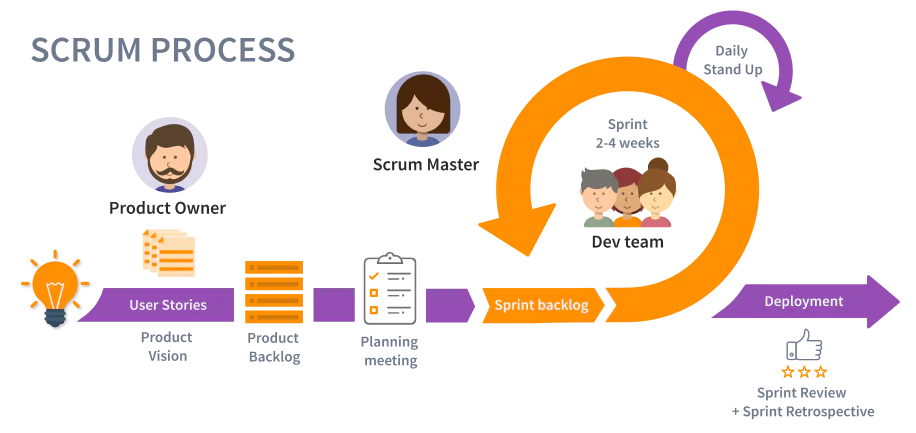
© tuleap
Who participates in the daily scrum?
The
**daily scrum**
is a
**daily meeting**
concerning only the members of the company working on the sprint: the
**development team.**
As its name suggests, the Scrum Master is in charge of leading the meeting. Their role is to create a conducive atmosphere for exchange and teamwork. Finally, their main objective is to make sure that their presence is no longer necessary afterward, i.e. to make the team autonomous.
The Product Owner does not necessarily participate in these meetings, although their role is major in the development and realization of the product.
The 4 advantages of the daily scrum
The
**daily scrum**
has many advantages, both in terms of corporate communication and for the well-being of employees:
It provides
**energy**and
**motivation**to scrum team members.
It creates
**cohesion**in the team: collaborators share their feelings, their progress and try to give advice to each other. The daily scrum is not the place to create controversies or debates.
It makes sure that nobody goes in the
**wrong direction**with regard to the sprint objective. In this sense, it promotes the
**empowerment**and
**determination**of the participants.
Finally, the
**daily scrum**guarantees the
**coordination**of the team members’ work. By presenting the
**daily tasks**and the progress of each team member, it is easier to keep track of what still needs to be done to reach the final
**sprint goal.**
Each team member must be heard.
The average speaking time is estimated to be 1-2 minutes. Of course, the time can be lengthened or shortened depending on: the schedule, the project, the number of people in the team or the topics to be discussed.
How to organize a daily scrum?
Anticipate potential obstacles
Although the implementation of the
**daily scrum**
may seem extremely simple, several
**obstacles**
may arise during its implementation and hinder the progress of the sprint tasks. These obstacles may appear during the team’s questioning.
Faced with any type of problem, the team, and, in particular, the
**Scrum Master**
(
**SM)**
, are required to look for effective solutions. If the
**SM**
is not able to find an adequate solution, another reference person must be called upon.
The following list is composed of examples of
**obstacles**
that your team may encounter and that may prevent the daily scrum from running
**smoothly**
:
Technical problems
caused by a computer malfunction,
Problems related to the use of software,
Personal issues
that may affect work,
Communication problems
and
**information sharing.**
✅
**Our advice**
: if the problem takes up time, it is better to postpone the discussion to a later date and in a different context. The
**daily scrum**
is primarily used to exchange and not to solve problems.
The daily scrum can be conducted in many ways, according to the team’s preferences.
There is not really a fixed structure, and you are free to establish your own
**methodology**
and process!
7 rules to follow for the daily scrum
This
**daily meeting**
may still seem blurry, so here are a few tips from us to plan the perfect daily scrum:
As indicated in its name, the
**daily scrum**should be set up every day. However, depending on your team’s organization and conditions, the frequency may vary. Sometimes, it is even more productive to hold this meeting every other day in order to have a more
**global follow-up**of the team’s effort.
The daily scrum should be scheduled at a time that is convenient for all participants and should not be changed too often to avoid potential
**oversights**by members.
As the daily scrum is a short and
**dynamic meeting,**it is recommended that all members keep standing.
A visual aid such as a
**task board**or
**storyboard**is very important to have. Indeed, it is useful to see the current progress of each sprint task at a glance.
We strongly advise you to always keep the meeting to a maximum of
**15 minutes.**As mentioned, the meeting is chaired by the
**Scrum Master,**who acts as a
**mediator.**The presence of this role avoids overlap or indecision as to who should speak.
When speaking, it is a good idea for
**team members**to focus on the relevance of the questions to the
**sprint objective.**
The daily scrum: a must-have for all companies
Although it may seem to be a purely formal event, the
**daily scrum**
is actually an essential moment for the team. With an overview of the tasks performed the day before and the tasks to be performed during the current day, it is possible to give an insight into the
**progress of the sprint.**
Beyond that, thanks to the
**continuous improvement**
and
**updates**
of the sprint, the daily scrum allows the synchronization of the team members’ work and the improvement of motivation. Indirectly, it allows a case-by-case follow-up of all members.
In addition, the meeting helps to identify possible obstacles but also to
**visualize**
more clearly what is missing to reach the goal.
So what are you waiting for? Time to jump on board and hold your very own
**daily scrum meetings**
!